
Knowledge base · Field test
During a summer field test we placed the Vormair heat generator in front of a wind machine and measured how much warmer the air it drew in became. With the wind machine running, the intake air rose by +6–10 °C above the surrounding air on every rotation — again and again.
A wind machine produces no heat of its own — it only mixes the air. On a still, frosty night the coldest air collects near the ground, with a warmer layer sitting above it; the wind machine stirs these two layers together. The Vormair heat generator adds real extra heat to this: placed in front of the wind machine, the machine draws in the already-warmed air and spreads it across the orchard.
To put this extra heat into numbers, we ran an instrumented measurement one summer night. We placed the heat generator next to the wind machine and mounted four data-logging thermometers behind the propeller — spaced vertically.
The measurement
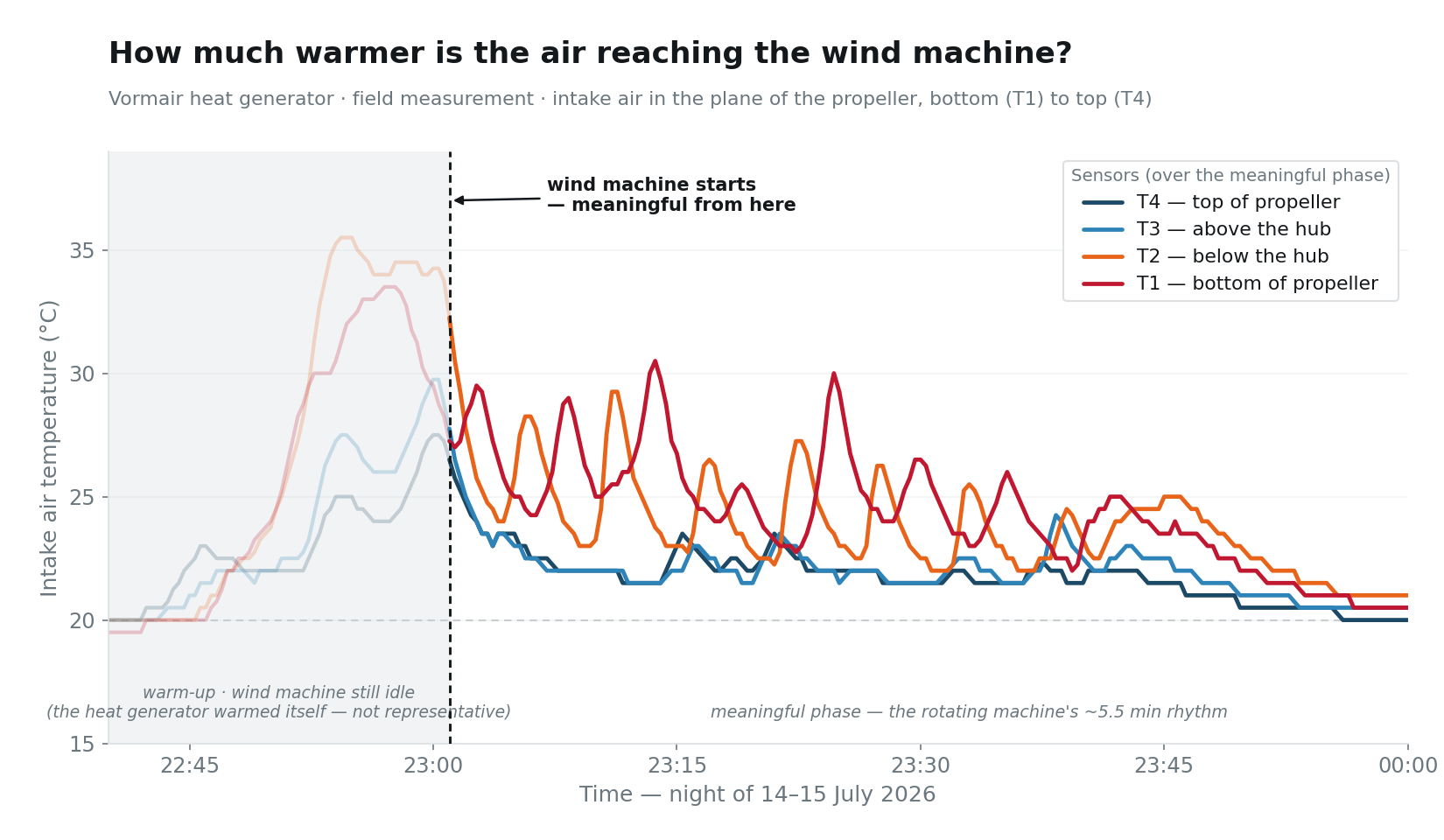
The chart splits into two phases. First we lit the heat generator, and only started the wind machine a little later. The faint section on the left shows this warm-up phase, so that part does not yet show relevant data.
The important part begins where the wind machine starts, and the curve shifts into a rhythmic pulsing. In this meaningful phase the intake air temperature jumped on every rotation: at the peaks the lower half of the propeller reached 28–30 °C, while the surrounding air was around ~21 °C — that is the +6–10 °C of extra heat the machine fed into the wind machine, rotation after rotation. At the end of the measurement, as we closed the test, the curve settles nicely back to the ambient level.
Why it pulses
The regular, recurring heat peaks have a simple cause: the wind machine does not stay in one place but rotates all the way around, a full turn taking roughly 5–6 minutes. Once per turn it faces exactly toward the heat generator — that is when it draws in the warmed air directly, and the temperature jumps. When it turns away from the machine, it takes in the cooler surrounding air, and the value drops back. The cycle time calculated from the measurement is ~5.5 minutes, which matches the wind machine's rotation time exactly — so the instrument traced out the machine's own rhythm. In an orchard, the rotating machine thus spreads the heat across the whole area.
It is worth knowing that these numbers show how much warmer the air becomes that the machine draws in from the direction of the heat generator. When the wind machine blows the other way, into the warm air above the heat generator, it spreads the heat across the orchard even more effectively.
How to read this
The Vormair TG-650 pellet-fired heat generator works as the heat source for a wind machine — automatic, controllable, and, according to the measurements, it delivers substantial extra heat to the protected area.