
Knowledge base · Sizing
The basic rule of sizing frost protection: how much energy has to be replaced on a frosty night — and what follows from that in practice.
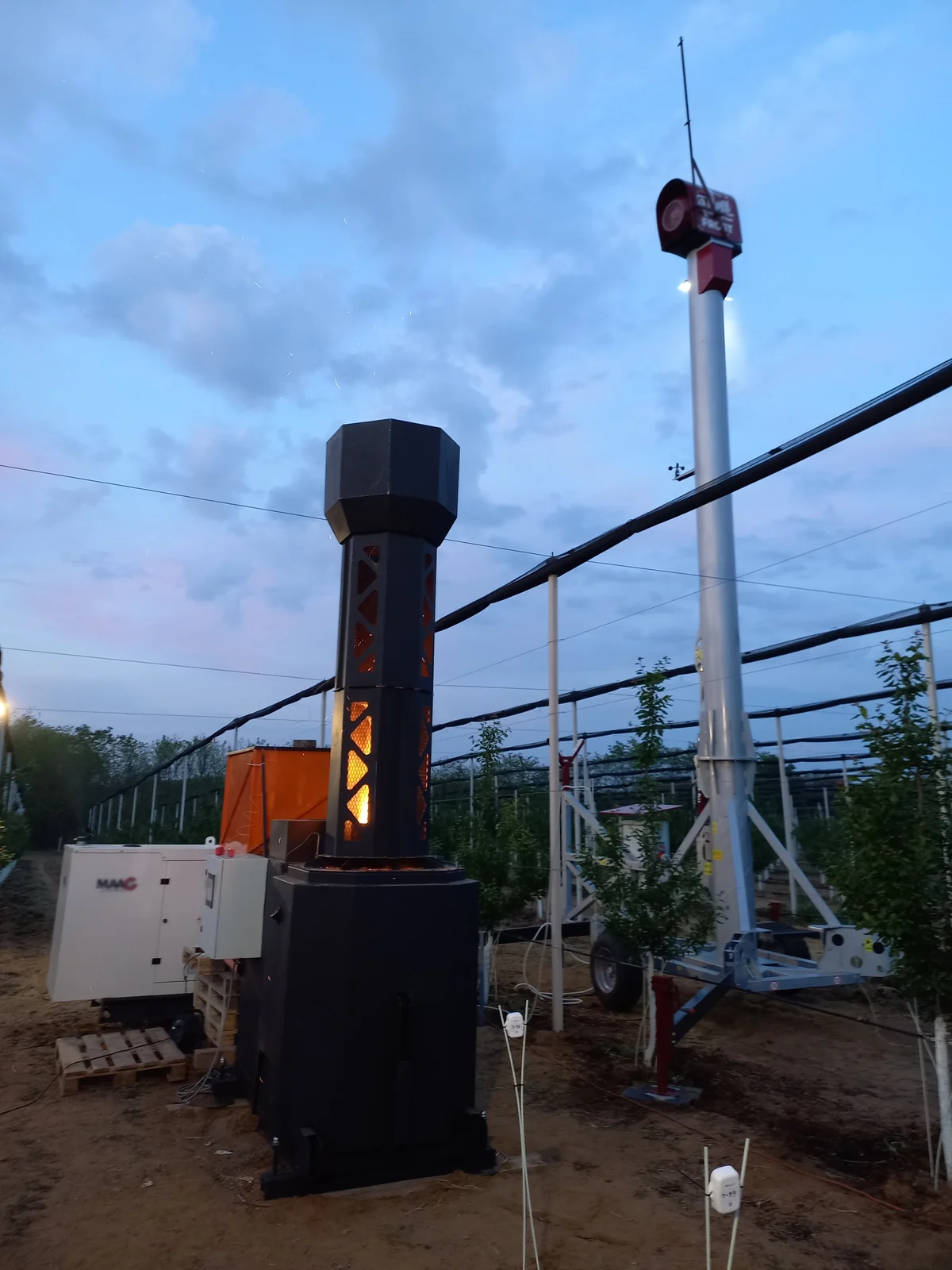
In spring 2026 the Hungarian agricultural portal Agrárszektor published a summary by Dr. Ferenc Apáti, head of the Institute of Horticultural Science at the Faculty of Agricultural and Food Sciences and Environmental Management, University of Debrecen (in Hungarian) on the basic rules of protecting against spring frost. The article states a concrete figure for how much energy has to be replaced on a frosty night. In this article we take that figure as our starting point and work through what a good frost-protection system is made of.
The benchmark
According to the article, on a clear, windless, radiation frost night an orchard loses 70–105 W/m² of heat — from ground radiation alone. That is 2,520–3,780 MJ per hectare per hour. Counting convective and other losses as well, successful protection needs more than this: the protection technology has to deliver 5,000–10,000 MJ/ha/hour of output energy; below that, “efficiency drops rapidly”.
It is worth translating this into the language of machines. One megajoule per hour equals 0.278 kW of continuous power, so 5,000–10,000 MJ/ha/hour effectively means 1,400–2,800 kW of heat output per hectare — all night long.
We treat this figure as our benchmark too. Every calculation below is built on it.
Reality check
Let us do the sums with our own machine. A Vormair TG-650 heat generator works at 650 kW of heat output, which is 2,340 MJ per hour. To reach 5,000–10,000 MJ you would therefore need 3–4 machines per hectare.
Four machines burn roughly 560 kg of pellet per hour; at a pellet price of 145 HUF/kg that is 81,200 HUF per hour — about 812,000 HUF per hectare over a ten-hour frost night. In a five-hectare orchard, the fuel bill for four frost nights would exceed 16 million HUF.
Let us say it plainly: this is a dead end. And it does not depend on the type of heat source — with candles, diesel or propane the same balance comes out even worse (we published a comparison of the fuels here). Simply “heating the orchard through” is not worth it for anyone — not even with our own machines.
Operating range
The other important lesson of the source article is that every protection method has its own operating range. With a weak inversion, methods based on mixing the air “bring no meaningful result”. Above 2–3 m/s of wind, the efficiency of heat-based methods deteriorates as well.
There is, therefore, no standalone device that covers every frost situation on its own. In practice frost protection is a combination of several methods: agronomy, air mixing and heat generation together.
Endurance
Spring frost is rarely the business of a single night. Frosts can last 3–5 consecutive nights, with 10–12 hours below freezing each night, and the next cold spell can start the whole thing again. Frost protection is therefore not built on a single charge but on endurance: the grower has to win the defence — with fuel, with money and with human effort alike.
Earlier frosts showed exactly this in a number of orchards: the fate of the crop was not decided on the first frost night but on the umpteenth one, when the fuel, the budget or simply the strength ran out and the defence stopped. Even the strongest technology on paper is worth nothing if it runs out of breath by the third night.
So the question is not necessarily only how much heat output can carry a single night, but which frost-protection technology can be sustained through an entire frost season, night after night. In that setup the wind machine, cheap to run, is the everyday base, and heat generation is the reserve deployed on the most critical nights — in such a way that using it is not even a question when you are already heating through the fifth night.
Measurement
That the heat of our generator really does end up in the air moved by the wind machine is not theory: we measured it in the field. In the air stream of the wind machine, after the heat generator was switched on, air arriving among the trees was 6–10 °C warmer on every rotation. We published the details and charts of the measurement in a separate article.
We are continuing the measurement series; our next question is how much of this surplus heat is put to lasting use at canopy level, across the whole protected area.
Honestly
For the sake of fairness, let us also say what this system cannot do. At exceptionally low temperatures, and in windy frost situations without an inversion, the efficiency of every technology available today deteriorates drastically. As the source article also writes, wind above 2–3 m/s does no good to heat-based methods either. There is no magic bullet.
What we do promise: a frost-protection solution that can be run economically from end to end through an entire frost season, in the frequent radiation frost situations. You can find the detailed operating figures here: How much does heating a frosty night cost?
If you would like to work out the sizing for your own orchard, get in touch with us.
Back to the knowledge baseThe Vormair TG-650 pellet-fired heat generator works as the heat source behind your wind machine — automatic, controllable, and with an operating cost that is sustainable through an entire frost season.